Zernio Review 2026: A Social Media API for Sprout Social Readers
Looking for sprout social? See how Zernio's API handles publishing, messaging, analytics and pricing, and when a calendar-first scheduler may be a better fit.
If you came looking for Sprout Social but need a developer-focused API, this Zernio review explains its publishing and messaging features, per-account pricing, and MCP setup. It also considers when a calendar-first scheduler may be a better fit.
Zernio is a single API for publishing, messaging, ads, analytics and phone numbers across 16 channels, built for developers and AI agents rather than marketers. I went through Zernio’s API surface, its per-account pricing and its MCP setup to explain what it does, what it costs at real account counts, and who should use something else.
Every social network has an API, and every one of them is a different shape, a different auth dance and a different set of rate limits. Zernio’s proposition is to absorb all of that behind one integration — “platform changes, token rotations, and rate limits are ours to absorb” — and to price it per connected account instead of per seat or per plan. That is an unusually developer-shaped promise, so I spent a week reading Zernio’s docs, quickstart, pricing page and feature matrix, and working through the SDK examples, to see how far it holds.
Since Zernio is deliberately an API rather than a place to plan content, I also kept a calendar-first scheduler with its own MCP and REST API, SupaPush, open in the next tab as the comparison for teams who need both — more on that at the end.
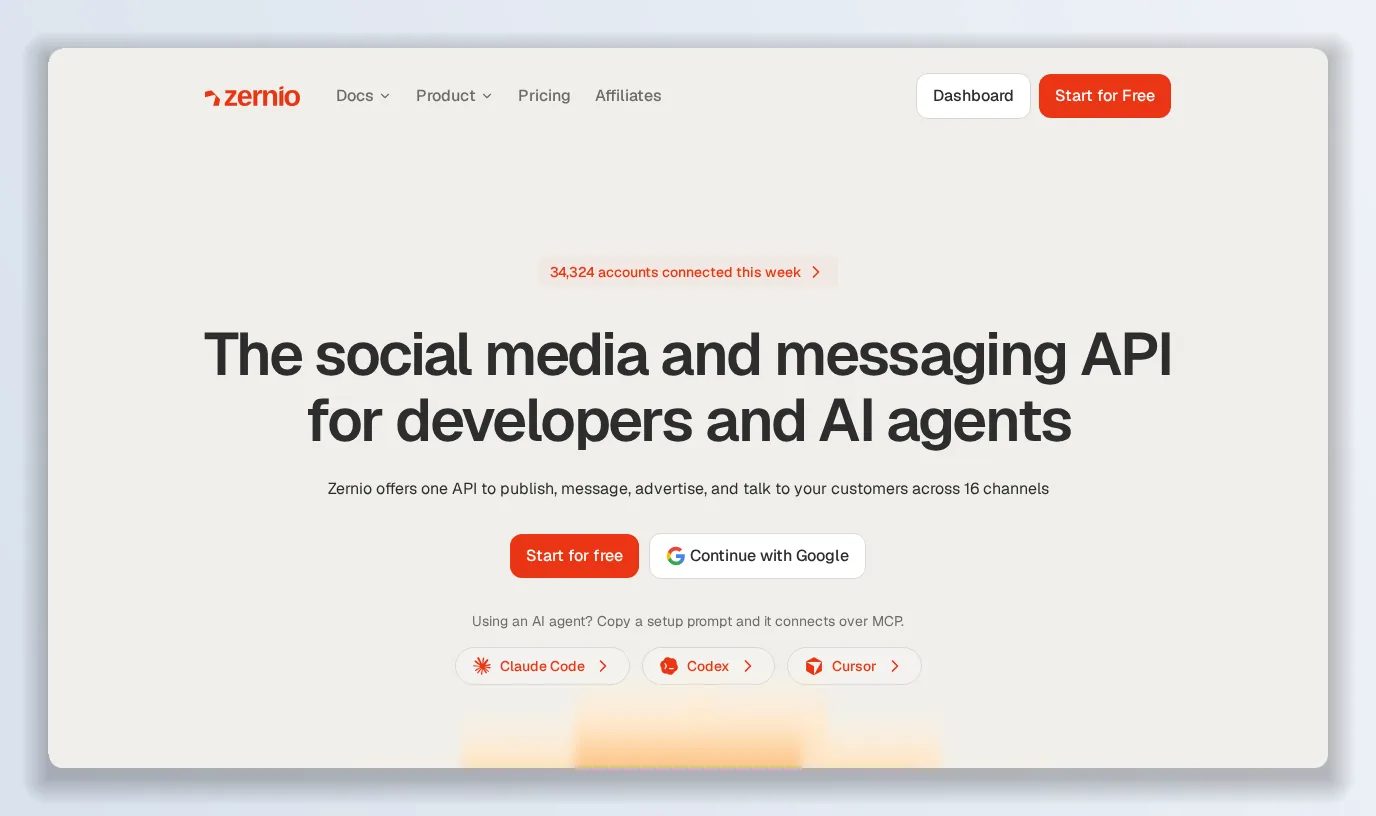
Zernio’s pitch is one API to publish, message, advertise and talk to customers across 16 channels — with setup prompts for Claude Code, Codex and Cursor.
What Zernio is
Zernio is social-media infrastructure for developers. One integration covers:
- Posting API — publish, schedule, thread, first-comment and queue across Twitter/X, Instagram, TikTok, LinkedIn, Facebook, YouTube, Threads, Reddit, Pinterest, Bluesky, Telegram, Snapchat, Google Business, Discord and Slack.
- Comments and messaging — reply to comments, manage reviews, read and send DMs, plus a “comment to DM” automation.
- Analytics API — impressions, reach, engagement and follower tracking across platforms.
- Ads API — Meta, Google, LinkedIn, TikTok, Pinterest, X and OpenAI Ads from one set of endpoints: create campaigns, ad sets and creatives, change budgets, pause and resume, read spend.
- Blogs API — create, edit, publish and delete WordPress and Shopify articles.
- Phone numbers, SMS/MMS, voice and WhatsApp — buy a number in 57 countries and run calls, texts and WhatsApp from it with carrier registration handled.
- Webhooks for post status, messages and comments, so nothing needs polling.
Zernio’s counter on the homepage claimed 34,322 accounts connected in one week and “70,000+ developers and builders”. The SDK examples are TypeScript-first; there is also a CLI and an MCP server.
Zernio for AI agents
This is the angle that makes Zernio different in 2026. Zernio publishes setup prompts for Claude Code, Codex, Cursor, OpenClaw, Grok bot and Hermes: you copy one prompt and the agent connects to Zernio over MCP. From there, an agent can post, reply, read analytics or adjust ad budgets on a schedule. The ad examples on the homepage — an agent raising a Meta ad set from $50 to $80 a day, pausing a TikTok retargeting campaign, then summarising spend across networks — are the clearest picture of who Zernio expects to be calling it.
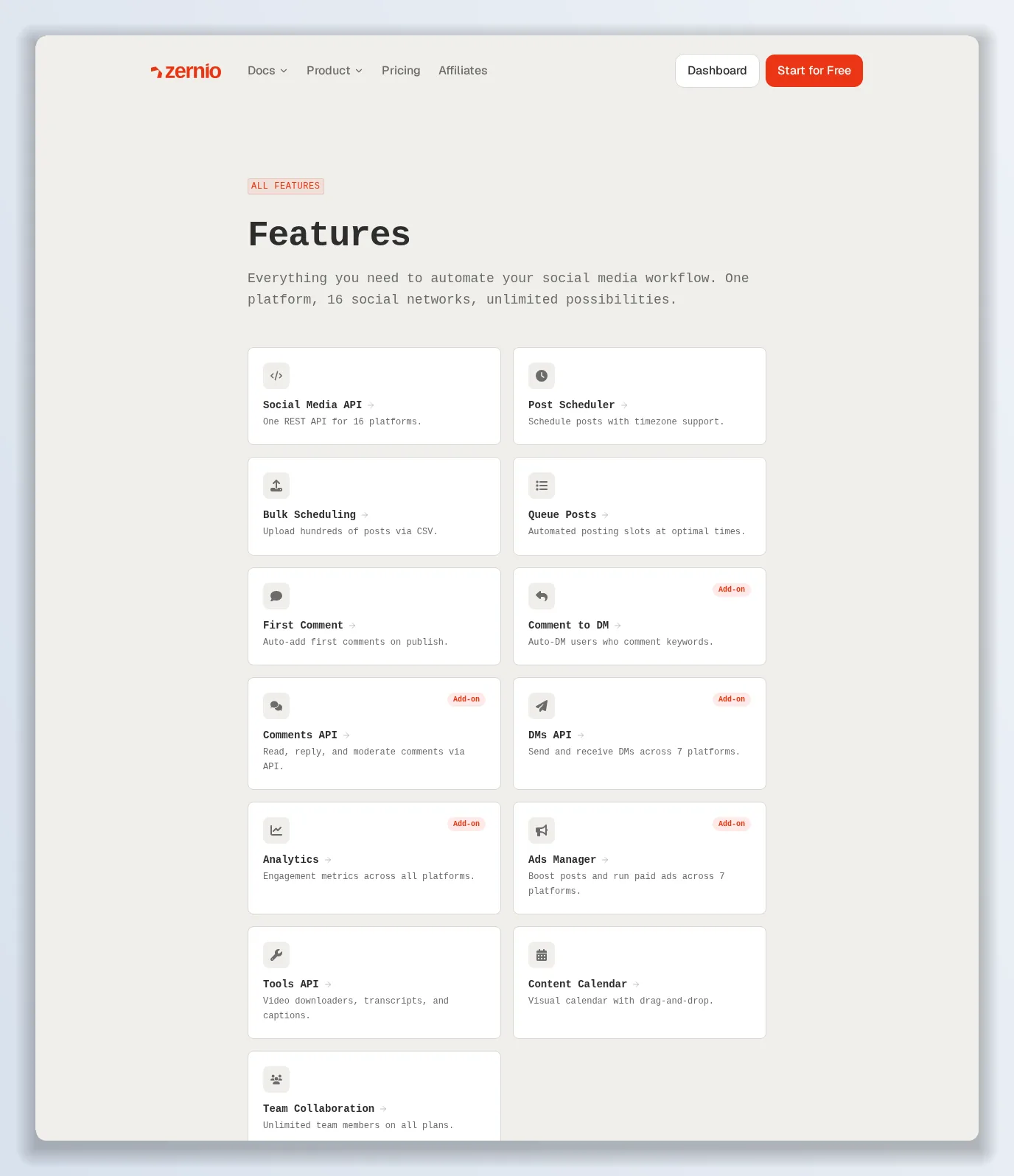
Every feature is included on every account; “add-on” items on Zernio’s feature page are metered rather than gated.
Getting started with Zernio
Zernio says you can go from signup to your first post, message, report or ad in under five minutes, and the quickstart supports that: authenticate, connect an account, call zernio.posts.createPost with media items and a list of platform/account targets, and the same payload fans out to Instagram, LinkedIn and TikTok. Two accounts are free with no credit card, which is enough to prove the integration before a card goes on file.
Zernio pricing: per connected account, no plans
Zernio’s pricing model is the most distinctive thing about it. There are no plans, no seats, and every feature is included on every account. You pay per connected social account, on a sliding scale:
- 1–2 accounts: free
- 3–10 accounts: $6 per account per month
- 11–100 accounts: $3 per account per month
- 101–2,000 accounts: $1 per account per month
- Enterprise (past 2,000 accounts): custom terms, SAML SSO, SCIM, MFA, audit logs, RBAC, a dedicated Slack channel and SOC 2 / GDPR paperwork.
Zernio’s own calculator example: 10 accounts = 2 free + 8 × $6 = $48 a month, about $4.80 per account. Managed ads are metered per active ad, phone numbers start from $3 a month, and X/Twitter API access is passed through at X’s exact rates with zero markup. Every call, message and number is an itemised line on the invoice, and billing is usage-based, cancel anytime, self-service at any scale.
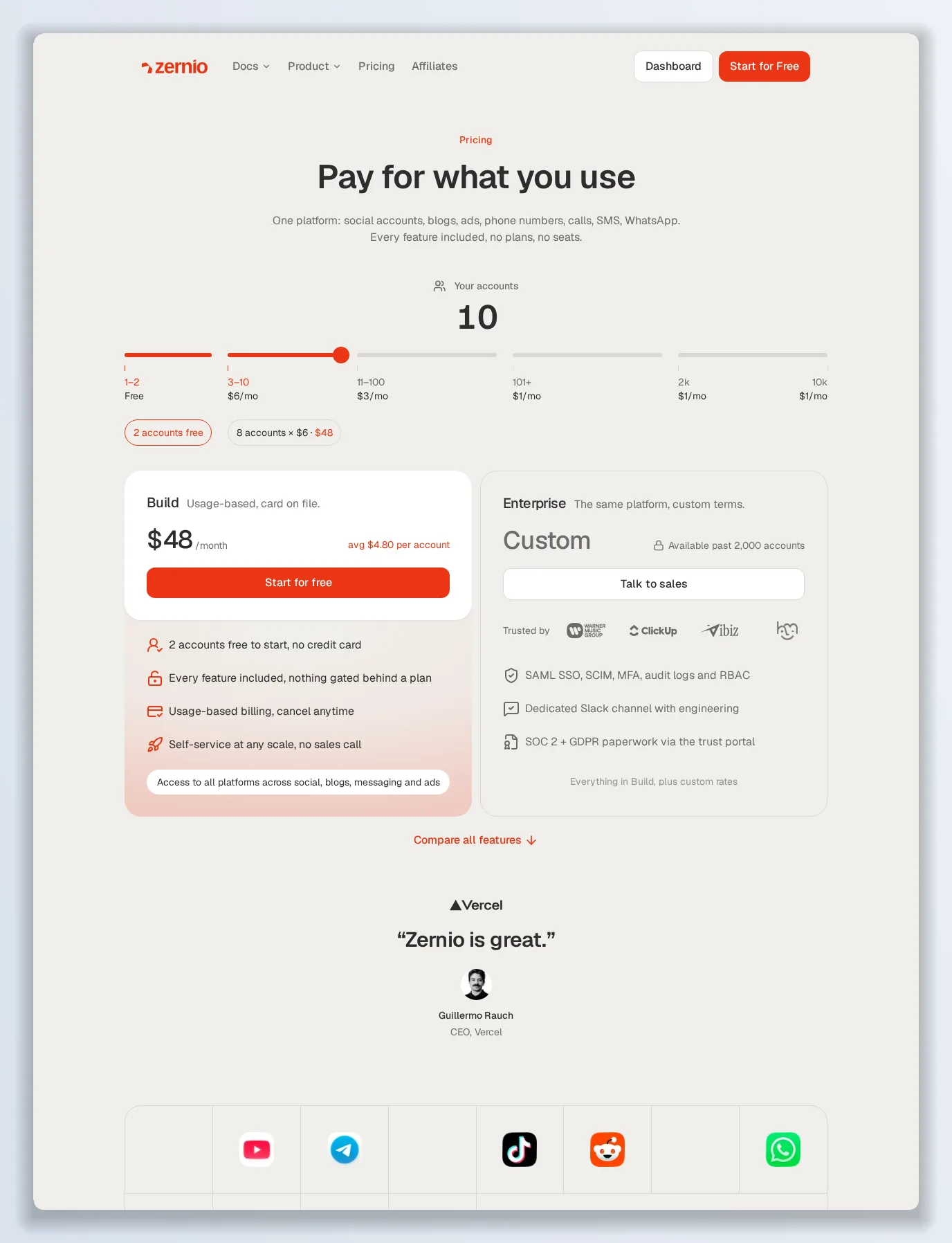
No plans and no seats — Zernio prices purely by the number of accounts you connect, with the rate falling as you scale.
Where Zernio is strong
- Breadth in one shape. Social, blogs, messaging, voice and ads under one SDK is rare; most competitors stop at posting.
- Agent-native. MCP server, setup prompts, and webhooks that replace polling make Zernio easy to hand to an autonomous agent.
- Honest pricing. Per-account, every feature included, itemised invoices, no sales call — Zernio’s model is easy to reason about and cheap at scale ($1 an account past 100).
- Zero-markup X access is a small but telling choice.
- Free to start, two accounts, no card.
Where Zernio falls short
- It is an API, not a workspace. There is no visual calendar, no approvals flow, no team roles for non-technical people. Zernio says so itself: it is “built for developers and teams with technical resources”.
- Expensive at the small end. Between three and ten accounts you pay $6 each — a solo creator with six profiles pays $24 a month for Zernio plus whatever front-end they build or buy.
- Metered extras add up. Ads per active ad, phone numbers, SMS and calls are all separate lines; the $48 headline is the floor, not the total.
- You still need somewhere to write. Zernio moves content; it does not draft captions, images or short video.
Zernio vs the alternatives
Against per-platform SDKs, Zernio wins outright on maintenance burden. Against marketer-facing schedulers, Zernio wins on API depth and loses on everything a non-developer touches. The interesting middle is a scheduler that is also an API — a calendar for humans and an MCP endpoint for agents on the same accounts — which is the gap I filled with SupaPush.
Verdict: is Zernio worth it in 2026?
For a developer building social, messaging or ads features into a product, or for anyone giving an AI agent the keys to real accounts, Zernio is one of the most complete and honestly priced options available. For a creator or marketing team that wants to plan a week of posts and approve them, Zernio is the wrong layer. Connect two accounts free and run the quickstart before deciding.
The alternative worth keeping next to it: SupaPush
Two Zernio limits kept me on a second tab: there is no calendar or approvals workflow for the humans on a team, and there is nothing to draft the content that the API sends. SupaPush is the scheduler that covers both while still exposing the same accounts to agents.
- A visual calendar plus an agent endpoint. Drag posts around a calendar for 10+ networks, or point Claude, Cursor, ChatGPT, Codex or OpenClaw at https://supapush.com/mcp with a Bearer token; underneath it is one calendar either way.
- AI Studio drafts the content — captions, images and short video — so the thing you schedule exists.
- Roles, approvals and a unified comments inbox for teammates who will never open an SDK.
- REST API v1, OAuth2, SDK and webhooks, plus n8n, Make and Zapier hooks.
- Flat pricing: $29 a month for unlimited scheduled posts, one workspace, 1,000 AI credits and API access at 100 posts a day; $99 for three workspaces, 2,000 AI credits and 500 posts a day.
If you are wiring social into a product or an autonomous agent, build on Zernio. If your team needs to plan, draft and approve posts — and still let an agent drive the same accounts — start with SupaPush.

Want to try it yourself?
Try Supapush →